Going Medieval: The Best Colony Builder Nobody Is Playing
By Milo Marsh ·
Here are two numbers. Going Medieval has just over twenty one thousand reviews on Steam. Manor Lords, which arrived three years later and occupies roughly the same medieval headspace, has ninety thousand. That is a four to one gap in favour of the newer game, and it exists despite Going Medieval holding the higher approval rating of the two.
We have been playing this thing since it hit Early Access in June 2021, back when it was held together with optimism. It left Early Access properly on 17 March 2026. Somewhere in those five years it turned into one of the best colony builders on the market, and almost nobody noticed.
The Short Version for RimWorld People
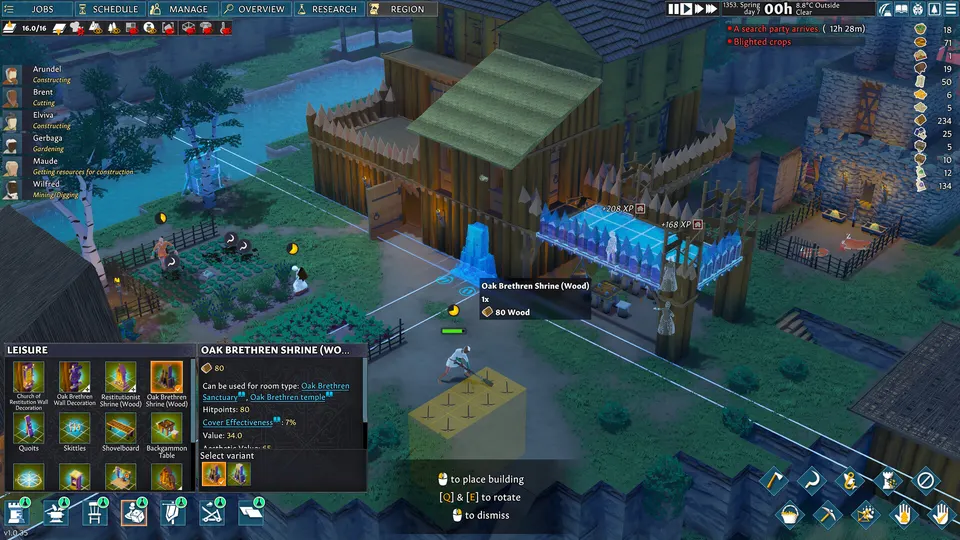
It is RimWorld with a Y axis. That sentence does most of the work, and if you have put thousands of hours into RimWorld the way we have, you already know whether you are interested.
The longer version: you land a handful of survivors in a wilderness that used to be civilisation, and the plague has done the rest. They need shelter before winter, food before spring, and walls before the raiders arrive in autumn. You do not control them directly. You set priorities and build orders and then watch your carpenter decide that now, during a siege, is the correct moment to haul one apple across the map.
Developer Foxy Voxel is a small studio out of Novi Sad in Serbia, published by Mythwright. Steam files it under Indie, RPG, Simulation and Strategy, which is four genres and still somehow undersells the spreadsheet lurking underneath.
The Third Dimension Is the Whole Argument
RimWorld is flat. Brilliantly, elegantly flat, and its entire design is built on that constraint. Going Medieval is voxel-based and stacks vertically, and the difference is much bigger than a camera angle.
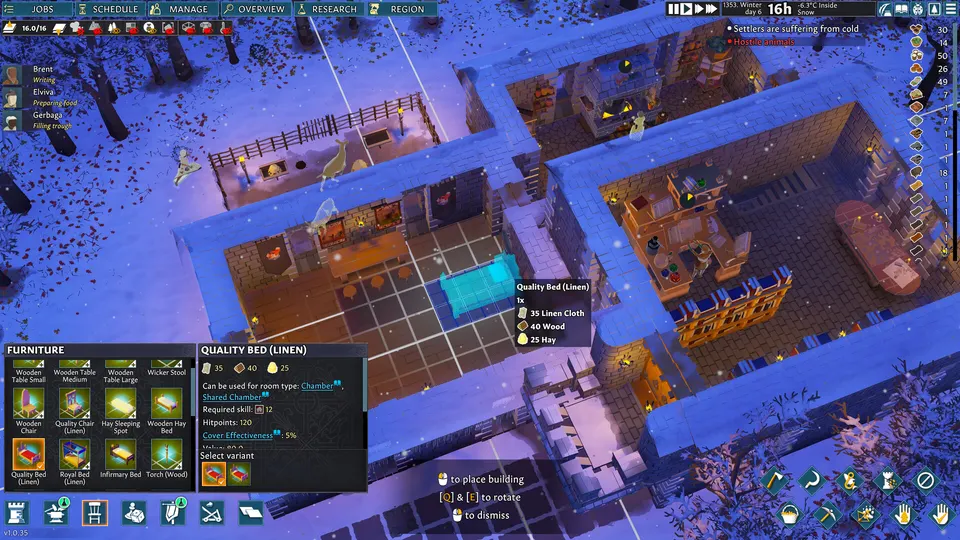
You dig into the hillside and put your food stores underground, where the temperature stays low enough that your winter supplies survive summer. That is not a cosmetic choice. Food spoilage is modelled, cellars are genuinely colder, and the first time you work out that the hill behind your camp is free refrigeration, the game clicks into place.
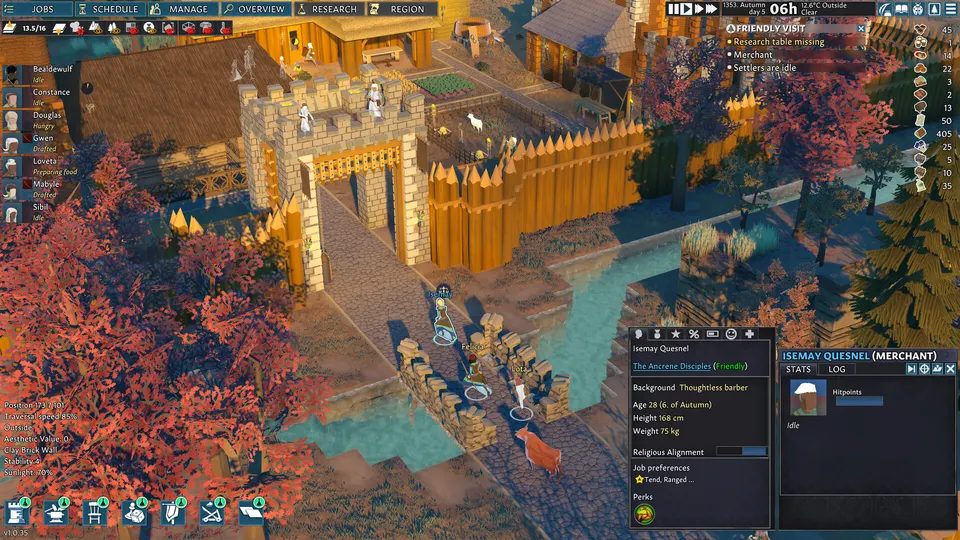
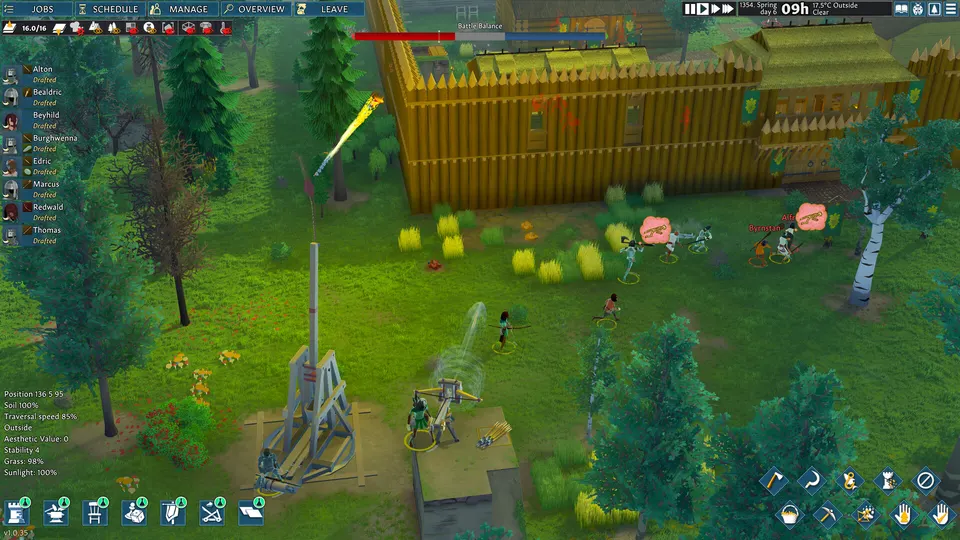
Then you build upward. Second storeys, towers with actual firing lines, walls with a walkway on top where your archers stand while the raiders mill about below trying to find a door. Roofing matters, because rain gets in and morale drops. Staircases matter, because a badly placed one turns your fortress into a bottleneck at the worst possible moment.
The result is that your base becomes a building rather than a floor plan. We have a save with a keep four storeys tall, cut into a slope, with the granary buried underneath and the barracks on top. Nothing in the flat-map genre lets you do that, and once you have done it, going back to a single plane feels like losing a limb.
What Five Years Actually Bought
The 2021 version was raw. That is not a criticism so much as a description. It had the voxel building, it had the survival loop, and it had very little else. You could see the shape of the thing through the gaps.
The 1.0 release is a different product. Production chains run deep enough to be worth planning around. Settlers arrive with traits and relationships and grudges. Raids escalate with a logic you can read. There are seasons, temperature, food preservation, injury and recovery, mood, and a research tree that gives the mid-game somewhere to go. Foxy Voxel shipped this steadily over five years rather than in one marketing burst, which is excellent for the game and terrible for publicity.
The current state is Very Positive on Steam, with just under nine in ten of those twenty one thousand reviews positive. For a small studio with no publisher muscle, that is a strong result.
The Manor Lords Problem
Now the part that annoys us. In 2024, Manor Lords launched into enormous attention, sold extremely well, and became the medieval building game that people talk about. It is a good game. It is also, by Steam’s own numbers, rated lower by its own players than Going Medieval is, sitting around eighty four percent positive against Going Medieval’s eighty nine.
Manor Lords had the trailer, the wishlist campaign, the streamer moment and the story about one developer building it largely alone. Going Medieval had a steady changelog. Guess which one gets recommended in threads asking for medieval building games.
This is how the market actually works and we have made our peace with it, mostly. The frustration is that the two games are barely competitors. Manor Lords is a city builder about growing a settlement and a region. Going Medieval is a survival colony sim about keeping eleven specific people alive through a winter. Wanting one does not preclude wanting the other, and yet only one of them shows up in the conversation.
Where RimWorld Still Wins
We should be honest about the gap, because it is real and it is not about the base game.
RimWorld has two hundred and forty five thousand reviews at ninety eight percent positive, which puts it in Overwhelmingly Positive territory and makes it the gold standard for the genre. More importantly it has a decade of modding culture. The Workshop is enormous, the big overhaul mods are practically their own games, and the community that grew around it produces stories that end up on the front page of forums with no context needed.
Going Medieval supports Steam Workshop and the sandbox is moddable, so the foundation is there. What it does not have is the scale of that ecosystem or the cultural reach that comes with it. You cannot conjure a decade of mod authors and a folklore of colonists eaten by their own livestock. That arrives with time and numbers, and Going Medieval has been short of numbers.
The Honest Caveats
It is single-player only, with no multiplayer or co-op, which for some people ends the discussion immediately. The pathfinding occasionally has opinions, as it does in every game of this type, and a settler will sometimes take a scenic route through a war. Verticality makes the interface work harder than a flat map does, and learning to read your own base across floors takes a few hours.
None of that is disqualifying. All of it is worth knowing before you spend money.
Should You Buy It?
Yes, and we say that with the confidence of people who have watched it grow up. It lists at around thirty dollars on Steam and goes on sale regularly there and on the other storefronts, at which point it becomes one of the easiest recommendations in the genre. Wait for a discount if you like. It will be along shortly.
Buy it if you love RimWorld and have ever wished you could build a basement. Buy it if Manor Lords left you wanting more survival and fewer supply-chain graphs. Buy it if you enjoy the specific satisfaction of designing a fortress that works, then watching eleven idiots move in and immediately test every flaw in your plan.
Skip it if you need multiplayer, or if the phrase “food spoilage is modelled” made you feel tired rather than excited.
Twenty one thousand reviews is not nothing. It is just an order of magnitude below what this game earned. Go and be one of them.
Screenshots courtesy of Foxy Voxel.
About the author
Milo Marsh
Hunting down the internet's most bizarre, stupefying, amazing and cool things for Moochly.